Modern Coffered Ceiling Design: Which Claims About Acoustics and Height Actually Hold Up?
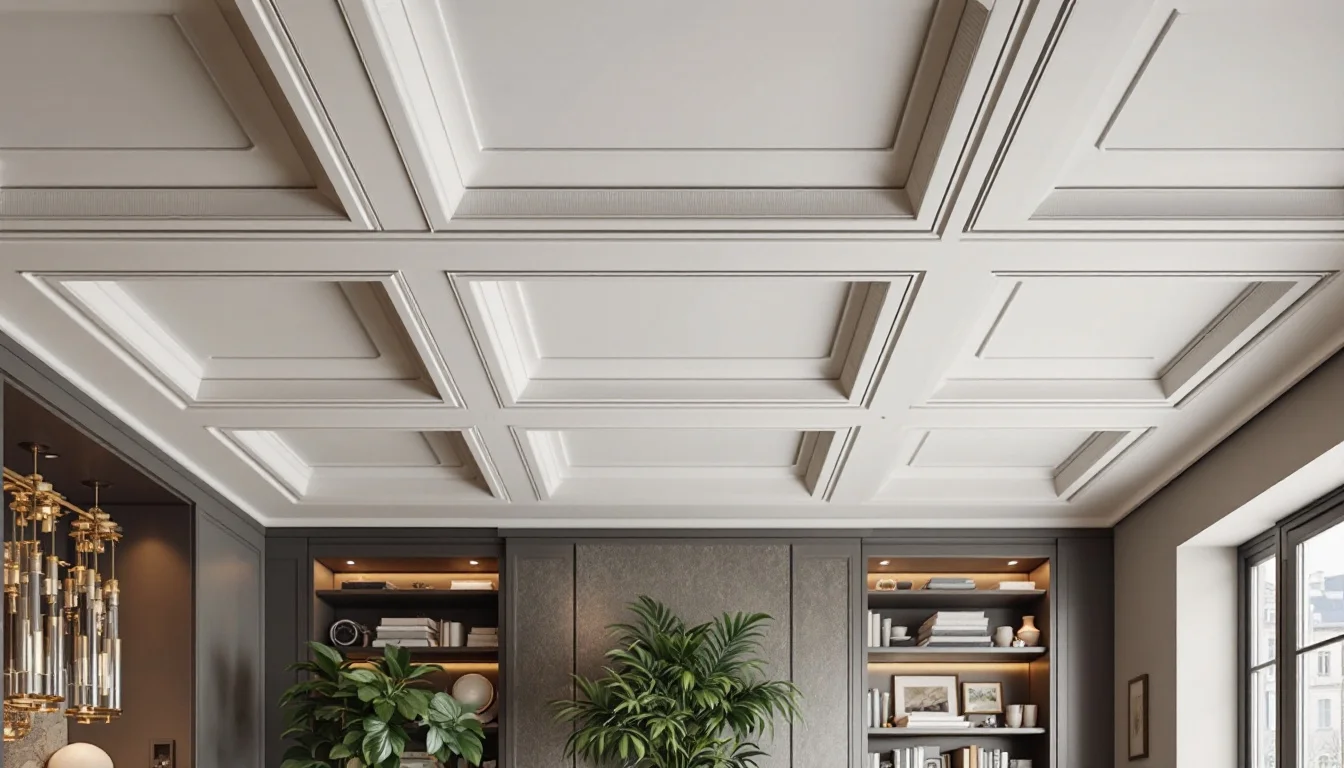
A coffered ceiling looks like a piece of furniture turned inside out: a grid of recessed panels, usually bordered by beams or mouldings, sitting overhead instead of underfoot. It appears alongside exposed beams, concrete soffits, slatted timber and two-level plasterboard as one of several "feature ceiling" options in renovation brochures. All of those systems carry similar marketing promises — better sound, a taller-feeling room, a more expensive look — and none of them are easy to verify from a sales page alone.
This article does not try to settle all of them. It sticks to what the available material actually documents in enough depth to check: coffered ceilings specifically, and the two claims attached to them most often — acoustics and perceived height. The question is simple. When a supplier says a coffered ceiling "improved acoustics" or creates "the illusion of increased height," what, exactly, is that claim resting on?
Key takeaways
- Acoustics claim: unverifiable as stated. No manufacturer in the material reviewed attaches a measurement, test standard or NRC (Noise Reduction Coefficient) figure to the phrase "improved acoustics."
- Height illusion claim: asserted, not explained. No source describes a mechanism by which a recessed panel grid changes how tall a room reads.
- Mirrors and skylights: mechanically plausible. Reflected and natural light are real, explainable effects — distinct from an unexplained "illusion."
- Hiding structural beams: holds up. This is a design-integration claim, not a performance claim, and needs no lab test to be credible.
- Cost and installation ease: no figures supplied anywhere in the source material. Treat affordability claims as marketing language until a supplier gives a quote.
What is a coffered ceiling, and is it really becoming more common?
Structurally, a coffered ceiling is defined by its grid: a repeating pattern of recessed panels set between beams or trim, deep enough to cast a shadow line around each square. One manufacturer's own description of the style attributes its appeal to the architectural interest and elegance this grid adds to a room — a reasonably defensible claim, since the visual effect of a recessed, shadowed grid is observable rather than asserted.
Why it is showing up in more ordinary renovations now, rather than only in grand interiors, is harder to pin down with hard data. One US wood-ceiling manufacturer, ASI Architectural, has noted that the ceiling was a largely ignored surface in modest architecture for decades, confined mostly to high-end homes and commercial buildings. That is a qualitative observation about the US market from a manufacturer with a product to sell, not a dated statistic and not a description of how any other national market has moved. It is worth reading as context, not as a local rule of thumb.
Claim-by-claim: what does the evidence actually show?
Strip the promotional language away and five claims recur across coffered-ceiling marketing. Here is what each one is actually supported by, based on the material examined.
| Claim | What's claimed | Evidence supplied | Editorial verdict |
|---|---|---|---|
| Improved acoustics | Installing a coffered ceiling "improved acoustics" | No measurement, test standard or NRC figure attached | Unverifiable as stated |
| Illusion of increased height | The recessed grid creates "the illusion of increased height" | No mechanism described in any source reviewed | Unverifiable as stated |
| Room feels larger and brighter | Mirrored inserts set into panels reflect light | Reflection is a described, physical mechanism | Mechanically plausible |
| Hides structural beams | Coffered design can be built around existing support beams | Described as a design-integration technique, not a performance claim | Holds up on its own terms |
| Easy and affordable installation | Ceilings can be installed "easily and affordably" | No cost figures, unit rates or prices given | Unverifiable as stated |
The pattern is consistent. Where a source describes a physical mechanism — light bouncing off a mirrored surface, a beam folded into a design feature — the claim stands on its own. Where a source uses an adjective with nothing behind it — "improved," "affordable" — or an unsupported selling word like "illusion" — there is nothing to check, because nothing measurable was offered in the first place.
If not the shape, what actually opens up a room?
That height claim remains unsupported by any mechanism in the sources reviewed, as established above. But three things in the same material do change how a room is actually perceived, and all three are worth separating from that vague claim.
The first is daylight. Skylights or light wells can be built into the coffered grid itself, a detail recommended for naturally dim rooms such as bathrooms and sunrooms. This is not an illusion — it is more light entering the room, which is a measurable physical change, not a trick of perspective.
The second is mirrored inserts set into panels. Mirrors reflect whatever light already reaches them — daylight, fixture light, or both — and bounce it further into the room, which genuinely increases the amount of brightness and movement a person perceives in the space. Reflection is a described physical mechanism, not a vague appeal to "illusion"; it is simply a different effect from the height claim, and should not be confused with it.
The third is fixture lighting. Lighting integrated into the recessed panels is described as a way to highlight architectural detail and create a well-lit atmosphere. Again, this is a real change to how much light is in a room and where shadows fall, not a property of the grid pattern by itself. All three mechanisms explain genuine before-and-after differences a homeowner would notice. The grid shape, on its own, explains none of them.
Do coffered ceilings actually absorb sound?
The acoustics claim deserves a closer look, because the same promotional material that asserts "improved acoustics" with no backing also happens to mention specific acoustic-rated product lines — tile ranges such as Ecoustic Ceiling Matrix, Ecoustic Torque and Ecoustic Sculpt — that are offered in coffered formats.
That detail is worth sitting with. Acoustic absorption in a ceiling tile comes from the material itself — typically a fabric-wrapped or textured panel designed to absorb sound energy rather than reflect it. A coffered grid is a shape: recessed panels bordered by beams. Nothing about cutting a flat ceiling into a grid pattern changes what the panel surface is made of.
The likely source of the confusion, then, is simple: these acoustic product lines happen to be available in coffered formats, and the two separate facts — "this panel absorbs sound" and "this panel is shaped like a coffer" — get folded into a single marketing line that implies the shape itself is doing the work.
The practical takeaway for anyone pricing a project: ask a supplier for the NRC rating or absorption data sheet of the specific panel material being quoted, not confirmation that the ceiling is "coffered." The word describes a shape. On its own, geometry can change how sound reflects and scatters around a room, but that's a different effect from absorption, which is what an NRC rating actually measures. The word says nothing about what the panel is made of or how much sound it absorbs.
Colour, pattern and finish: the choices that don't need a lab test
Several parts of coffered-ceiling design are straightforward aesthetic choices, with no performance claim attached and therefore nothing to verify.
- Paint: panels can be painted to match or contrast with the rest of the room's colour scheme.
- Wallpaper: applied inside the recessed sections, it adds pattern and texture without altering the structure.
- Metallic finishes: tin or copper surfacing gives the grid a more contemporary look, often used in corporate spaces and restaurant dining rooms.
- Geometric variation: a more modern take replaces the traditional square grid with hexagons or triangles.
The cost per m² you won't find here — and why
One recurring line in coffered-ceiling marketing is that these designs can be installed "easily and affordably." No cost figures, unit rates or price ranges accompany that claim in the material reviewed, so none are repeated here as if they were real numbers.
What is practical, in the absence of a published figure, is how to ask for one. A coffered ceiling is not a single line item — it combines a frame structure, a panel material, in some cases an acoustic lining, and installation labour. Request an itemised quote that separates those four elements rather than a single lump-sum price. That breakdown is also the only reliable way to confirm whether an "acoustic" product is actually fitted with a tested absorptive panel, or simply shaped like one.
FAQ
What's the practical difference between a coffered shape and an acoustic-rated panel? Shape and material are two separate specifications. A coffered grid describes the geometry; an NRC rating describes sound absorption. If a quote bundles "acoustic" and "coffered" into one line item, ask for them to be itemised separately — the panel material and its performance data should be identifiable on their own, apart from the frame and the shape.
Does a coffered ceiling need extra height to install? None of the sources reviewed specify a minimum recess depth, so this can't be answered in general terms. It depends on beam depth and the existing ceiling void. Check with the installer before assuming a standard ceiling height is enough.
Can a coffered grid hide ductwork or wiring as well as structural beams? The material confirms that coffered designs can be built around existing structural beams as a feature rather than an obstruction. Whether the same grid can conceal ducting or wiring runs is a reasonable extension of that idea, but it isn't confirmed anywhere in the sources reviewed — worth raising directly with an installer before assuming it.
Conclusion
Acoustic-rated ceiling products already exist in coffered formats, based on the supplier material reviewed here. That makes supplier catalogues worth watching for a specific reason: not whether the grid pattern stays fashionable, but whether manufacturers start publishing NRC data by default instead of leaving the word "acoustic" to do the work on its own. Based on the material available now, that shift hasn't happened yet.